News Desk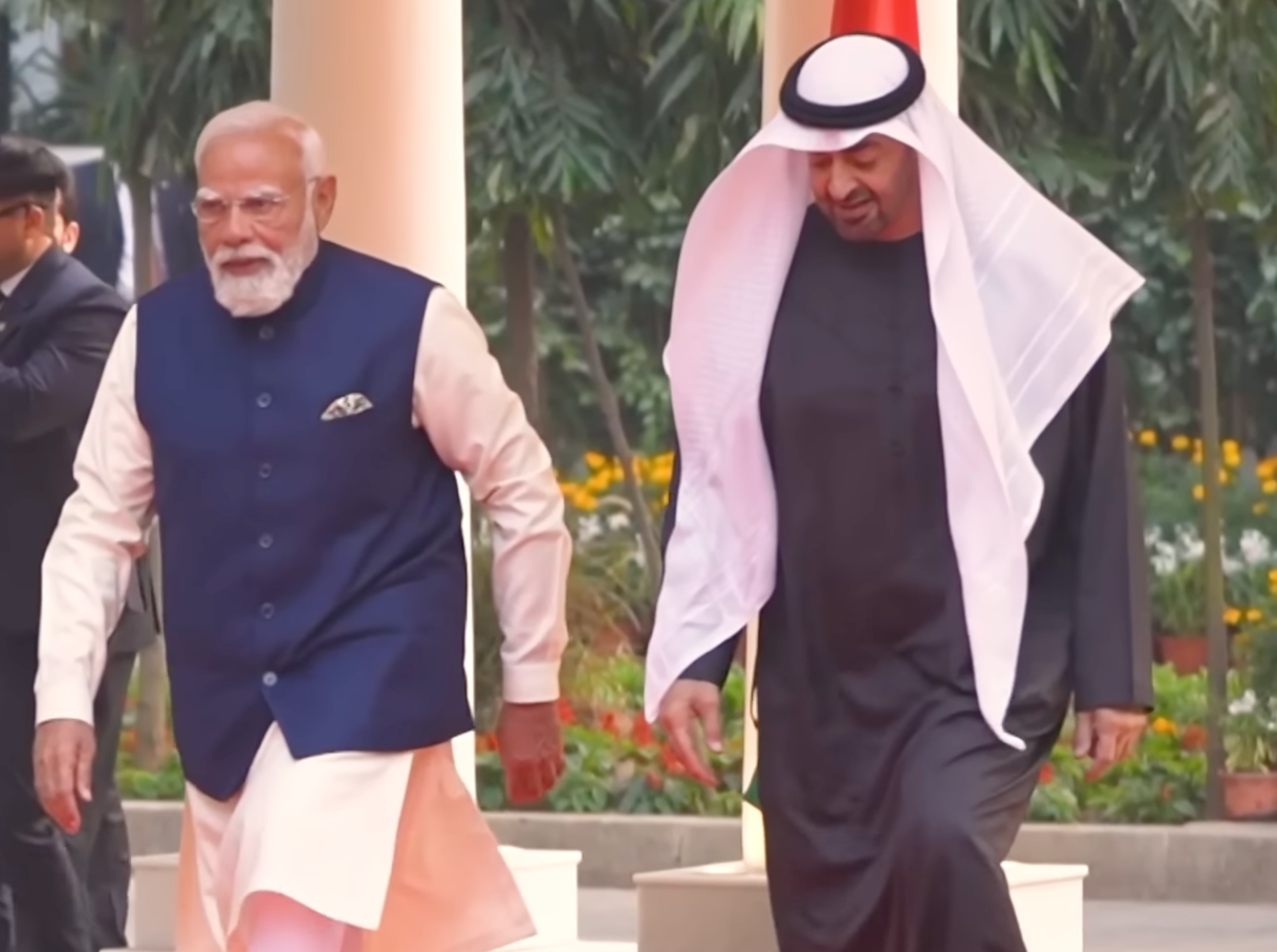
PM Modi and Sheikh Mohamed bin Zayed expanded their strategic roadmap to include innovation, space, and SMR-based civil nuclear energy.
NEW DELHI: India and the UAE have launched a roadmap for a strategic defense partnership alongside a 10-year LNG supply agreement for 0.5 million tonnes annually. Prime Minister Narendra Modi and UAE President Sheikh Mohamed bin Zayed Al Nahyan have also committed to doubling bilateral trade, setting an ambitious target of $200 billion by 2032.
In a display of close personal ties, PM Modi welcomed Sheikh Mohamed bin Zayed (MBZ) to New Delhi with a hug upon his arrival. The two leaders traveled together in the same vehicle to the Prime Minister’s residence, a gesture highlighting the strategic weight India places on its partnership with the UAE. The West Asian nation remains a vital energy supplier and home to nearly 4.5 million Indian nationals.
Despite the brevity of the three-hour visit, Prime Minister Modi and President Sheikh Mohamed bin Zayed (MBZ) conducted a comprehensive review of bilateral ties, identifying innovation, space, and civil nuclear energy—specifically Small Modular Reactors (SMRs)—as key pillars for future collaboration. A major digital milestone was also reached, with instructions to interlink national payment platforms to facilitate more efficient cross-border transactions.
Furthermore, the two nations signed a Letter of Intent to establish a “Strategic Defence Partnership Framework Agreement.” This pact will deepen cooperation in areas ranging from defense manufacturing and cyber-security to special operations and counter-terrorism. Foreign Secretary Vikram Misri clarified that this defense alignment is a natural progression of existing ties and is not intended as a response to regional conflicts or a signal of Indian military involvement in West Asian disputes.
Citing the success of previous joint exercises, Foreign Secretary Misri explained that the upcoming defense pact will transition the relationship toward industrial collaboration and high-tech partnerships. The roadmap includes deeper educational exchanges and potentially elite-level training sessions between the special forces of both countries.
He said, “We plan to look at defense industrial cooperation, partnerships in advanced technology, as well as expanding linkages in training, education, and perhaps training between the special forces of the two countries,” he said.
“I would characterise it as a natural evolution from the already considerable defence cooperation between the two countries, and not necessarily a response to any specific event that may have taken place in the region…”
Both leaders reaffirmed their commitment to strategic autonomy, identifying defense and security cooperation as a “core pillar” of their partnership. They issued a strong, joint condemnation of all forms of terrorism, particularly cross-border terror, and pledged continued collaboration through the Financial Action Task Force (FATF) to dismantle terror financing and money laundering networks.
On the energy front, a landmark agreement was reached between Hindustan Petroleum (HPCL) and ADNOC Gas. The 10-year deal, valued at approximately $3 billion, secures the annual supply of 0.5 million tonnes of LNG to India starting in 2028, reinforcing the UAE’s role as a critical partner in India’s long-term energy security.
Following the implementation of the Sustainable Harnessing and Advancement of Nuclear Energy for Transforming India (SHANTI) Act, 2025, both nations have committed to exploring advanced nuclear technology partnerships. This collaboration will focus on the deployment of large-scale reactors and Small Modular Reactors (SMRs), alongside joint efforts in plant operations and safety protocols.
Economically, the leaders celebrated the “robust growth” spurred by the 2022 CEPA, which saw bilateral trade hit a historic $100 billion in 2024-25. Buoyed by this momentum, PM Modi and Sheikh Mohamed bin Zayed set a new target to double this figure to $200 billion by 2032. The UAE remains a vital pillar of India’s energy security, currently serving as the fourth-largest source of oil and second-largest supplier of LNG and LPG.
India and the UAE have formalized a major investment partnership to transform the Dholera Special Investment Region (SIR) in Gujarat into a global industrial and logistics hub. The agreement between the Government of Gujarat and the UAE Ministry of Investment outlines the development of critical infrastructure, including an international airport, a greenfield port, a smart urban township, and specialized aviation facilities such as a pilot training school and an MRO (maintenance, repair, and overhaul) center.
Parallel to this, the two nations are venturing into the “New Space” economy. A joint initiative between IN-SPACe and the UAE Space Agency will focus on commercializing space technologies, developing launch complexes, and establishing accelerators to nurture space startups. To further solidify trade, a new memorandum on food safety was signed to streamline technical requirements, specifically designed to boost Indian exports of rice and other agricultural products to the UAE, thereby enhancing regional food security.
PM Modi and MBZ are redefining the bilateral relationship through a lens of tech-sovereignty and strategic finance. By inviting UAE wealth funds into the 2026 NIIF Fund II and launching a joint supercomputing cluster, the nations are moving from a buyer-seller model to a co-innovation partnership. The most visionary outcome is the “Digital Embassy” initiative—a secure safe harbor for sovereign data designed to withstand geopolitical and physical threats. Both leaders underscored that this partnership remains a cornerstone of regional stability and a key driver of the IMEC corridor.
Sheikh Mohamed bin Zayed’s (MBZ) arrival in New Delhi followed a sharp escalation in tensions between the UAE and Saudi Arabia over the conflict in Yemen. The long-standing rivalry between the two Gulf powers broke into the open in late 2025 after UAE-backed Southern Transitional Council (STC) forces seized control of the strategic, oil-rich Hadramaut and al-Mahra provinces from Saudi-supported government forces.
The friction reached a critical point on December 30, 2025, when Saudi Arabia conducted airstrikes on the port of Mukalla, targeting what it claimed were Emirati weapons shipments intended for the STC. Following a rapid Saudi-led counteroffensive and a subsequent decree from the Yemeni government, the UAE announced the complete withdrawal of its remaining counter-terrorism units from the country in early January 2026, marking a pivotal shift in its regional military engagement.

 Raymon Stephens
 Alok Kumar