Why Abu Dhabi Just Won the “World’s Safest City” Title for the 10th Year in a Row

In a landmark achievement for urban governance, Abu Dhabi has been officially crowned the safest city on the planet for 2026. This marks a full decade of dominance at the top of the Numbeo Global Safety Index, a feat that reinforces the UAE capital’s reputation as the gold standard for public security and quality of life.
The 2026 report, which meticulously evaluated 400 cities across more than 150 nations, placed Abu Dhabi at the number one spot. The ranking is based on comprehensive metrics, including the ability to walk alone safely during both day and night—a core indicator of a city’s social health.
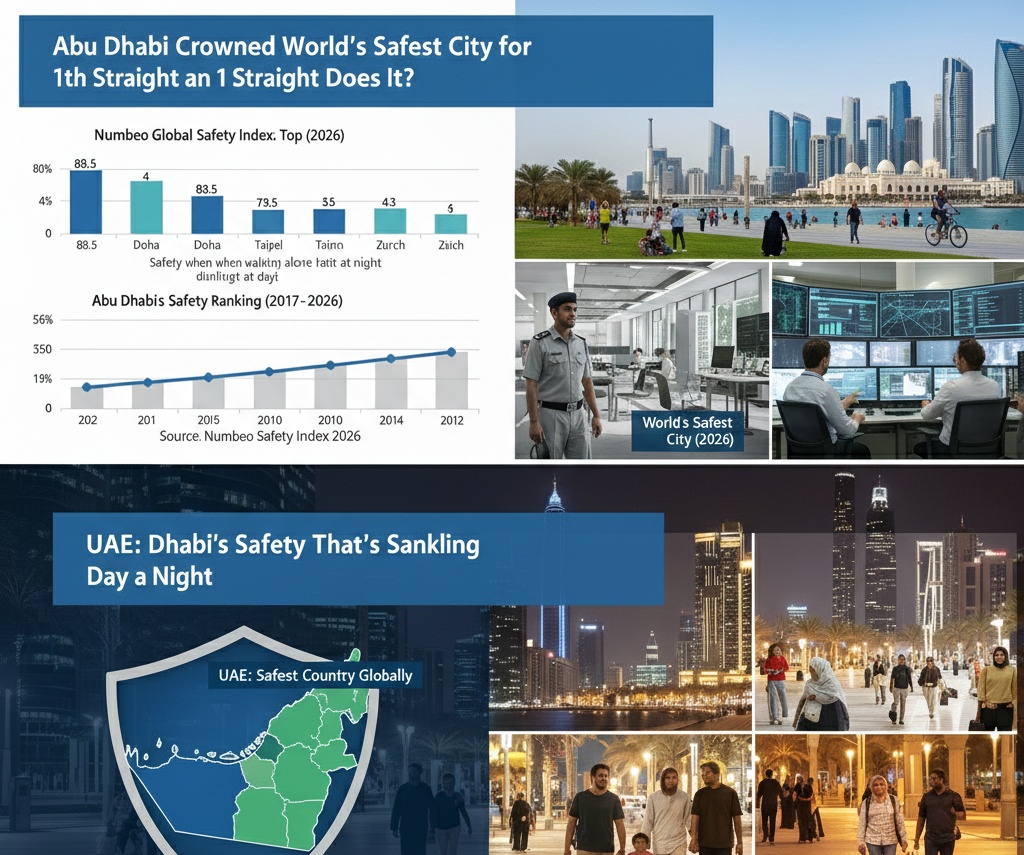
A Decade of Defending the Top Spot (2017–2026)
Abu Dhabi’s journey to the top began in 2017. Since then, it has consistently outperformed major global metropolises to retain its crown. Unlike many cities that see fluctuating crime rates, the UAE capital has maintained an unbroken streak for ten years.
According to Numbeo’s crowdsourced data, the city excels specifically in:
- Perceived Safety: Low levels of concern regarding crime.
- Public Comfort: High confidence in public spaces.
- Nighttime Security: Exceptional scores for “safety when walking alone at night.”
“This achievement is the result of a wise leadership vision and the continued support of President His Highness Sheikh Mohamed bin Zayed Al Nahyan, combined with an integrated institutional approach,” stated Major General Ahmed Saif bin Zaitoon Al Muhairi, Commander-in-Chief of Abu Dhabi Police.
The “Invisible” Shield: AI and Predictive Policing
While you might not see a police officer on every corner, the city is heavily protected by what some call an “invisible shield.” The Abu Dhabi Police have spent the last few years leaning hard into predictive technology.
Major General Ahmed Saif bin Zaitoon Al Muhairi, Commander-in-Chief of Abu Dhabi Police, attributes this success to a mix of advanced digital tools and artificial intelligence.
“This achievement is the result of a wise leadership vision and the continued support of President His Highness Sheikh Mohamed bin Zayed Al Nahyan, combined with an integrated institutional approach,” Al Muhairi recently stated.
The goal isn’t just to catch criminals; it’s to use data and AI to stop incidents before they even happen. By the time you’re walking down a street, the city’s systems have already analyzed risk factors to ensure your path is clear.
Safety as an Economic Engine
For the 200+ nationalities living in the UAE, safety is more than just a statistic—it is a reason to stay. Recent data suggests that nearly one in five expatriates now intends to remain in the UAE long-term, citing the nation’s stability as a primary factor.
| Metric | Impact of Safety in Abu Dhabi |
| Tourism | Increased footfall at landmarks like the Louvre Abu Dhabi and Yas Island. |
| Investment | Higher confidence for global businesses to establish regional HQs. |
| Liveability | High demand for family-friendly residential zones and open-air promenades. |
A National Culture of Security
Abu Dhabi’s success isn’t an isolated event. The latest Numbeo data shows a broader “UAE Safety Dominance,” with Ras Al Khaimah, Ajman, and Sharjah also appearing in the global top five. Dubai follows closely, ranking 6th worldwide. This collective performance has positioned the United Arab Emirates as the safest country globally for 2026.
Why This Matters for 2026 and Beyond
In an era of global economic and geopolitical shifts, Abu Dhabi’s decade-long reign offers a case study in urban resilience. By focusing on “safety when walking alone at night” and “safety when walking alone during the day,” the city has created an environment where families, workers, and tourists can thrive without fear.
As the city enters its second decade at the top, the message is clear: safety is not a one-time win, but a sustained commitment to innovation and community trust.