Sovereign AI: India’s Secret Weapon Against the US and China, Says Dell Exec
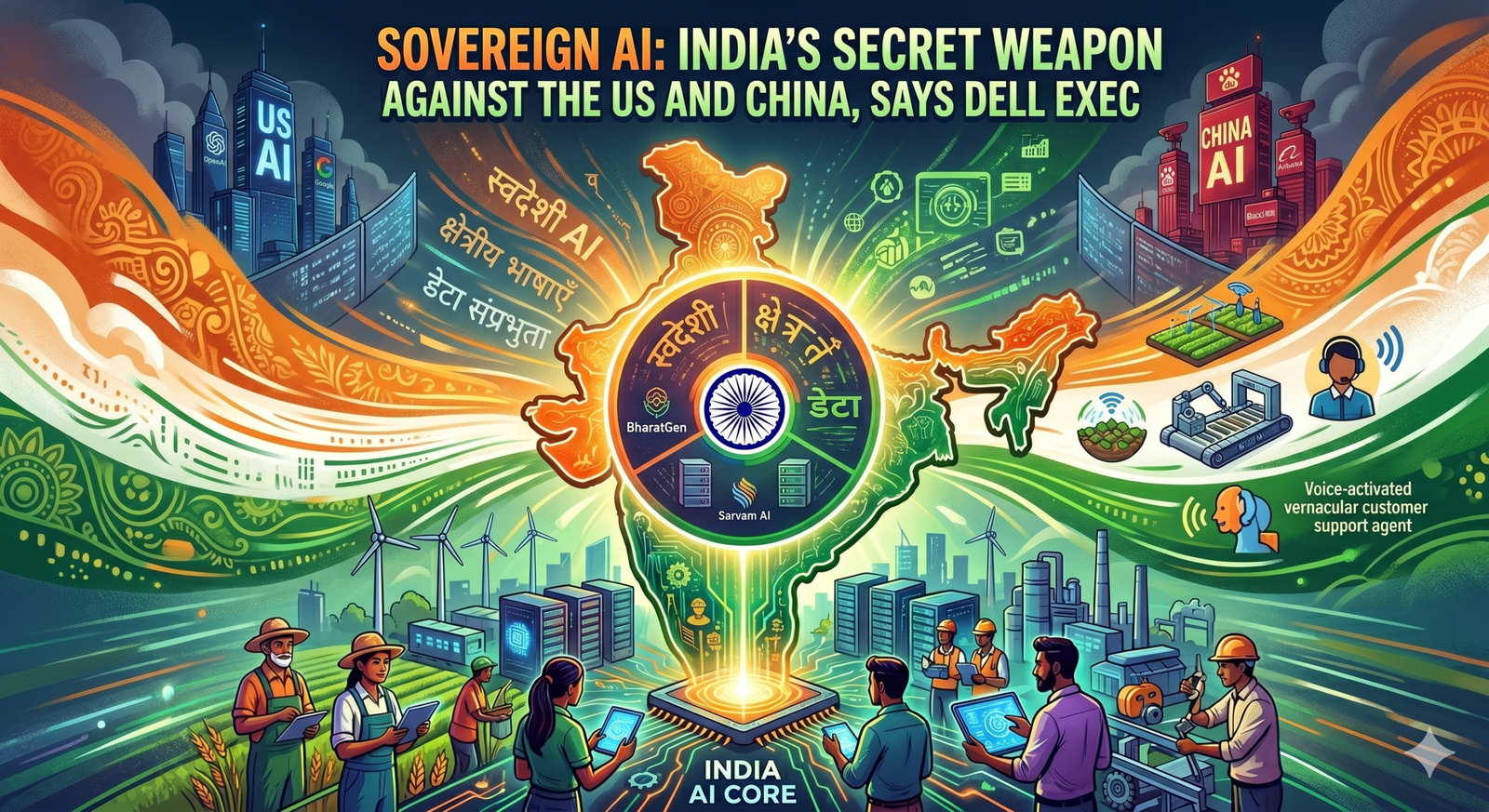
LAS VEGAS — As the global artificial intelligence race intensifies, India’s focused push into “Sovereign AI” may give it a structural competitive advantage over tech superpowers like the United States and China, according to a top executive at Dell Technologies.
Speaking at the Dell Technologies World event in Las Vegas, Satish Iyer, Vice President of Innovation and Ecosystems at Dell, highlighted that the gap between raw, foundational “frontier” models built by global tech giants will narrow over time. Instead, the real battleground for market success will shift toward highly localized, context-driven systems.
Winning with Context and Language
While massive monolithic models dominate global headlines, they heavily lack coverage of regional nuances. For instance, the world’s most popular AI chatbots still do not support all of India’s 22 official languages.
“I think where it actually becomes important is in how countries like India are driving sovereign models locally,” Iyer said. “Languages are important, as is bringing in vertical and regional context. I don’t think there is anyone who can do that better than India.”
India is actively developing domestic, sovereign platforms like Sarvam AI and BharatGen. These systems are built, owned, and regulated within national borders, ensuring that critical public data and infrastructure remain securely under national jurisdiction.
Driving Value in Core Sectors
Rather than chasing the largest parameter models, Indian enterprises are focusing heavily on localized optimization. Iyer noted that this targeted approach will drive immense value across massive domestic verticals:
- Agriculture: Powering hyper-efficiencies across India’s vast agribusiness scale.
- Manufacturing: Introducing AI-driven automation and precision process optimization.
- Customer Support: Enhancing English-speaking, back-office operations while breaking linguistic barriers locally.
To support this domestic shift, substantial local investments are channeling directly into dedicated data centers and localized cloud setups to make computing costs highly manageable.
A Challenge to India’s Tech Talent
While the Indian government’s $1.2 billion AI Mission budget is modest compared to the multi-billion-dollar war chests of US or Chinese conglomerates, Iyer believes India’s true secret weapon is its vast pool of engineering graduates.
However, he challenged young professionals and startups to look past basic task execution and embrace systems-level thinking.
“AI can perform specific tasks very well, but there has to be someone who can stitch everything together,” Iyer concluded. “Young people entering the job market need to develop this systems-level thinking, which allows them to think about how all these things fit together in ways AI cannot.”