India Nuclear Energy Breakthrough: PFBR Achieves Criticality at Kalpakkam
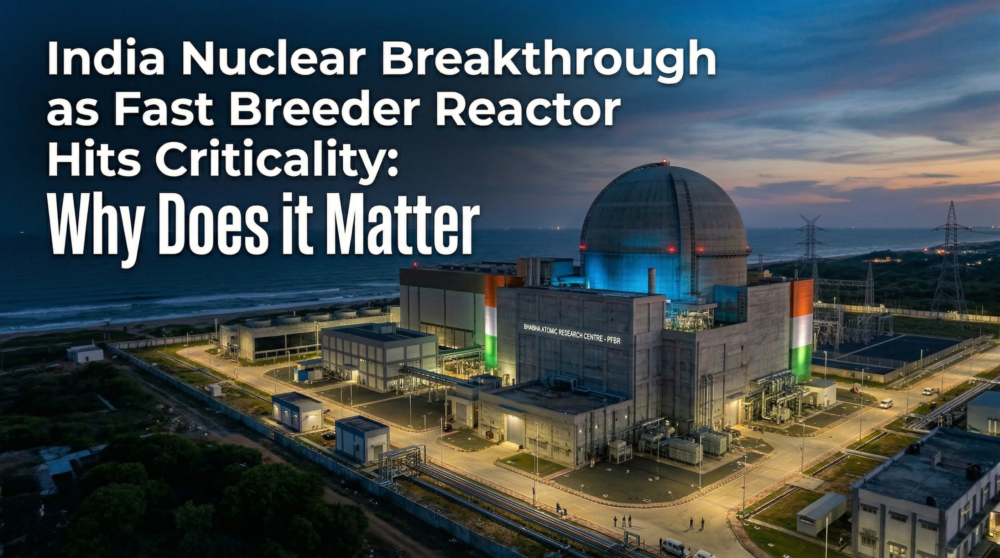
India just hit a massive “green light” in its quest for energy independence. The Prototype Fast Breeder Reactor (PFBR) at Kalpakkam has officially achieved criticality. For those of us following the energy sector, this isn’t just a technical win—it’s the moment India’s long-term nuclear vision finally became a reality.
By reaching this milestone, India has effectively unlocked the door to a future where fuel scarcity might become a thing of the past.
PFBR Criticality Explained: India’s Stage-2 Nuclear Reactor Milestone
So, what actually happened on April 6, 2026? In simple terms, the reactor reached a self-sustaining nuclear fission reaction.
Think of it like starting a car engine that then keeps itself running. This is the heart of Stage 2 of India’s three-stage nuclear program. Unlike standard reactors, the PFBR is designed to “breed” plutonium from uranium. Achieving criticality proves that the reactor’s core design is sound, safe, and ready to maintain the steady chain reaction needed to generate 500 MWe of power.
Why PFBR is a Game-Changer for India’s Nuclear Energy
The PFBR isn’t your run-of-the-mill reactor; it’s a “fast breeder,” and that distinction is everything. Here is why this matters for the average citizen and the global market:
- Fuel Efficiency: It produces more nuclear fuel than it consumes. It’s essentially a battery that recharges itself while it works.
- Energy Security: By utilizing plutonium, India drastically reduces its reliance on expensive uranium imports.
- Waste Management: These reactors are much better at “burning” long-lived radioactive waste, making the process cleaner.
- Scalability: It provides a reliable, low-carbon base load for the national grid, helping meet the skyrocketing demand for electricity.
PFBR and the Future of Thorium Reactors in India
This is the real “holy grail” of the project. The PFBR is the essential bridge to Stage 3: the Thorium cycle.
India sits on some of the world’s largest thorium deposits, but thorium can’t start a fire on its own—it needs a “match.” The PFBR provides that match by creating the fissile material necessary to ignite thorium reactors. Once we successfully transition to thorium, India could potentially have enough clean energy to last for centuries.
Next Steps: From Criticality to Commercial Operation
While the celebrations are well-deserved, the work isn’t over. The team at Kalpakkam is now moving into a transition phase:
- Safety Testing: A series of rigorous low-power tests to ensure the liquid sodium coolant and control systems are behaving perfectly.
- Power Ramp-up: Gradually increasing the heat and steam production to spin the turbines.
- Commercial Grid Integration: If all goes well, full commercial operation is expected to begin by late 2026 or early 2027.
Once the switch is fully flipped, India will join an exclusive club—currently led by Russia—of nations capable of operating a commercial-scale fast breeder reactor.
Expert Reactions and Government Response
The mood in the scientific community is electric. Prime Minister Narendra Modi hailed the achievement as a “defining moment,” emphasizing that this was an indigenous victory for Indian scientists. Nuclear experts are already pointing out that this success validates decades of research by the Department of Atomic Energy (DAE) and BHAVINI.
India Nuclear Energy on the Path to Unlimited Power
The PFBR reaching criticality is the clearest signal yet that India is no longer just a participant in the global nuclear conversation—it’s a leader. By successfully navigating the complexities of Stage-2, the country is now on a direct path toward:
- Sustainable, long-term energy independence.
- A massive reduction in carbon footprints.
- The eventual rollout of thorium-based power.
India is proving that with enough patience and scientific grit, the dream of “unlimited” clean power is no longer science fiction. It’s happening right now in Kalpakkam.