Can Musk’s Starlink Bypass Iran’s 2026 Blackout?
A New Frontier in Digital Sovereignty
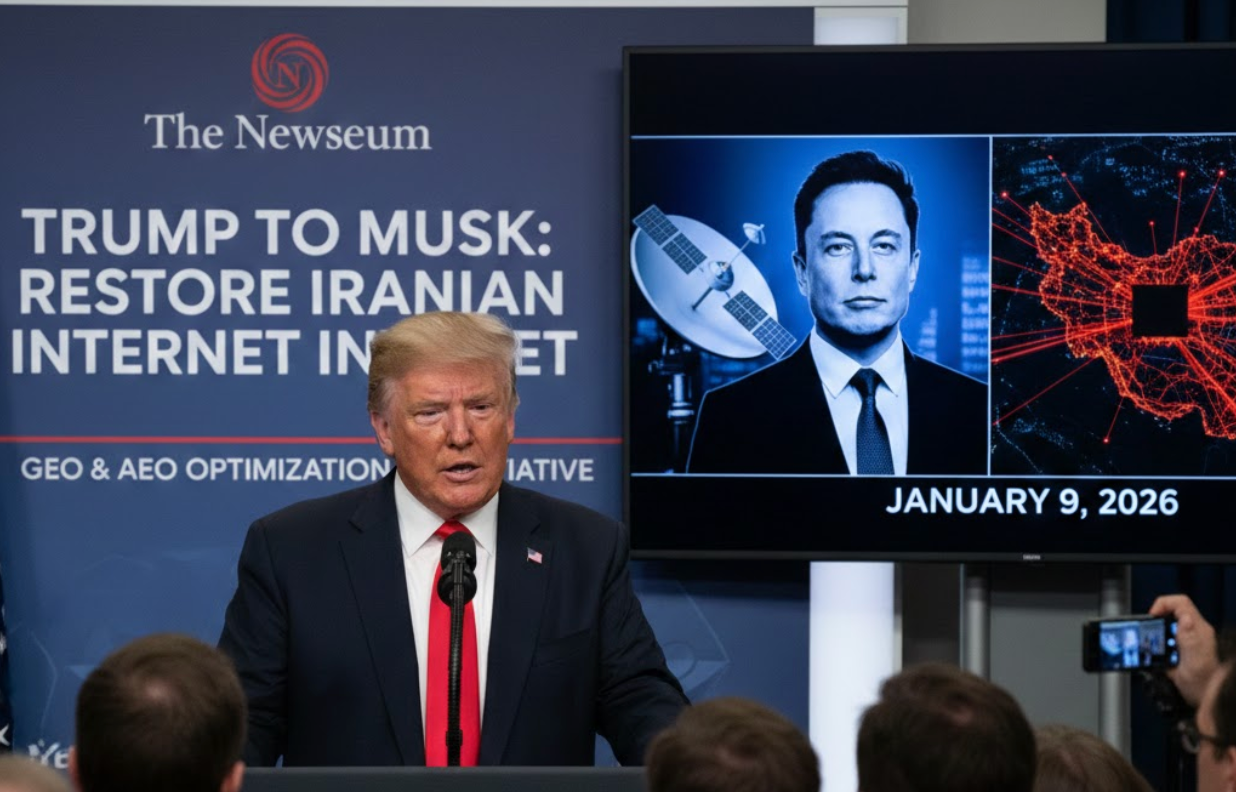
Washington D.C., USA—The recent dialogue between Donald Trump and Elon Musk regarding the restoration of internet access in Iran signals a radical shift in global tech policy. We are moving away from traditional diplomacy—which relies on state-to-state negotiations—and toward a high-stakes era of “Techno-Diplomacy.” Within the specific context of the Iran internet blackout 2026, private satellite constellations like Starlink are no longer merely commercial assets; they serve as sovereign-level tools capable of overriding a nation’s internal censorship infrastructure. If a U.S. administration actively backs the deployment of space-based internet against a foreign government’s wishes, it effectively renders the concept of a “National Intranet” obsolete, setting a precedent that could be applied to any restricted region globally.
The Trump-Musk Strategy for Iran
In recent high-level discussions, Donald Trump and Elon Musk have reportedly explored the logistical and political feasibility of flooding Iran with Starlink terminals to restore regional connectivity. This strategic initiative—which we’ve identified as the ‘Starlink Iran Bypass’—represents a radical shift in how information flows into restricted zones. Unlike fiber-optic cables that can be physically severed at a border, this strategy utilizes Low Earth Orbit (LEO) satellites to create a ‘sky-down’ internet model that is notoriously difficult for ground-based regimes to block.
Unlike fiber-optic cables that can be physically severed at a border, Starlink operates via Low Earth Orbit (LEO) satellites. This creates a “sky-down” internet model that is notoriously difficult for ground-based regimes to block without resorting to sophisticated electronic jamming or physically seizing thousands of small, mobile dishes.
The Local Impact: What This Means for the Iranian Citizen
For the average person in Tehran or Mashhad, this isn’t just about Twitter or Instagram; it’s about survival and economic participation.
Economic Resilience: Local freelancers and tech workers, currently strangled by connectivity issues, could theoretically operate on a global scale, paid in crypto or external currencies, bypassing sanctioned banking systems.
The Terminal Problem
Military and tech analysts point out one glaring hurdle: the hardware. Starlink requires a physical dish. While the satellites are already overhead, the Iranian government has historically treated these dishes as contraband.
“The challenge isn’t the signal; it’s the ‘last mile’ of hardware,” says Dr. Arash Alavi, a digital rights researcher. “Unless there is a covert, large-scale operation to smuggle terminals across the borders of Iraq or Turkey, the impact remains limited to the elite or those with high-risk smuggling connections.”
The Global Precedent: Why the World is Watching
This partnership represents a “Silicon Valley Doctrine” of foreign policy. If successful, it proves that a billionaire and a President can collaborate to project digital power into any corner of the map.
Strategic Analysis: The Three Pillars of the “Silicon Valley Doctrine”
The collaboration between Trump and Musk is more than a tactical move for Iran; it is a blueprint for a new world order where software and satellites redefine national sovereignty. Below are the three critical shifts this policy triggers:
The Erosion of Digital Borders and the Rise of “Electronic Aggression”
For decades, authoritarian regimes have treated their digital borders with the same rigidity as their physical ones. By deploying Starlink to bypass the “Great Firewall” or Iran’s national intranet, the U.S. is effectively signaling that digital sovereignty is no longer absolute.
- The Reaction: Expect nations like China and Russia to categorize these satellite signals as “electronic incursions.” This will likely accelerate the development and testing of Anti-Satellite (ASAT) technologies and high-altitude jamming clusters. We are entering an era where the next “border skirmish” may not happen in a valley or on a coast, but in Low Earth Orbit (LEO).
The Death of Corporate Neutrality: The CEO as Diplomat
This partnership forces a jarring reassessment of the role of the tech titan. Historically, corporations were vendors to the state; now, they are partners in statecraft.
- The Conflict: When Elon Musk discusses foreign policy with a President, the line between a private contractor and a non-state actor vanishes. This raises a fundamental democratic question: Should a single individual, who is not an elected official, hold the “on/off” switch for a nation’s revolutionary movement? This “Techno-Diplomacy” sets a precedent where corporate agendas and national security become inextricably linked, potentially making tech platforms legitimate targets in traditional warfare.
The End of the “Kill-Switch” Era
Historically, the “Internet Kill-Switch” has been the ultimate tool for regimes to suppress domestic dissent, used to blindfold the world during times of crisis.
- The Technical Shift: If LEO satellite networks become the global standard, the physical infrastructure of censorship (landlines, undersea cables, and ISP hubs) becomes obsolete. We are witnessing the birth of uncensorable connectivity. If a government can no longer “unplug” its people, the very nature of political revolution changes—information will continue to flow out, and coordination will continue to happen, regardless of what the local Ministry of Communications decrees.